


A Trip to Amsterdam, For Palestine
A reflection on the event Europe, Accountability & Palestine: a Shift in European Perceptions of International Law Violations in Gaza?
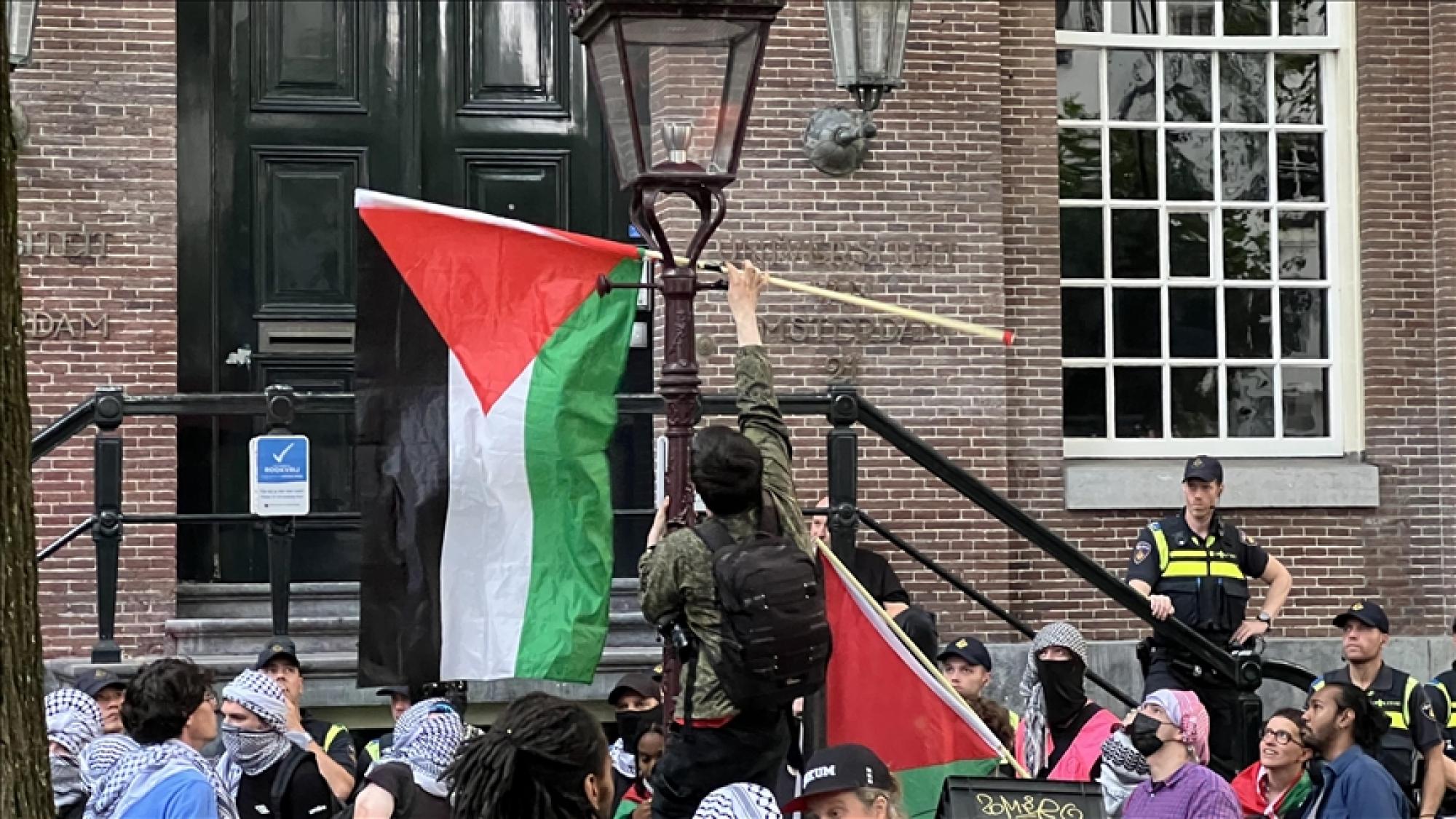
On 15 December 2025, I went with a colleague from the Centre de droit européen to Amsterdam, to attend an event organised by GEM alumna Pola Cebulak and other professors from the University of Amsterdam (UvA). The discussion concerned the situation in Palestine, analysed from a legal perspective.
I refer to the ‘situation in Palestine’ somewhat vaguely on purpose. This is because the event did not focus solely on the definition of genocide or the genocide itself, but also touched upon other illegal actions currently being pursued by EU Member States, and the EU itself, due to their inertia and support for Israel’s actions.
As wisely said by the Chair, Pola Cebulak, ‘the ongoing genocide in Gaza questions the very foundation of international law’: it questions the concept of consistency in international law, and it shows the dangerous risks of applying double standards in the international legal order. Israel is violating international law, full stop, but the international community is not able, or not willing, to react in a united fashion.
The roundtable hosted three speakers, two lawyers and one academic, who provided different insights and levels of analysis on the issue.
Understanding the ‘Duty to Prevent’ the Genocide
Professor Federica Violi from Erasmus University opened the discussion by explaining the violations committed by EU Member States and the broader international community regarding the Genocide Convention. She emphasised that the Convention does not only require States to intervene when a genocide is occurring but also mandates a duty to prevent it. Therefore, even if genocide is not yet definitively proven in a final ruling, the State Parties’ duties are activated as soon as there is an imminent risk of genocide. By ignoring this risk and continuing to support Israel’s actions, States are failing in their obligations under international law.
How to know whether a genocide is ongoing or whether the risk of genocide has materialized? The report of the UN Special Rapporteur on the situation of human rights in the Palestinian Occupied Territories, Francesca Albanese, is clear material, and also what is happening before the International Court of Justice in the pending case South Africa et al. v. Israel, for which the ICJ has already ordered Israel to stop its destructive actions in Gaza.
Therefore, what are the States and the EU waiting for?
Exporting Arms and Being Complicit in Killing Civilians: The F-35 and Leonardo Cases
Building on the discussion of genocide prevention, we explored not only the inaction of the EU and its States in denouncing what is happening in Palestine, but also their complicity in the genocide.
Under the Arms Trade Treaty (ATT), States are obliged to deny or reassess arms exports if there is a clear risk that the equipment will be used to commit serious violations of international humanitarian law, such as indiscriminate attacks on civilians. The problem is that it is very difficult to demonstrate that the arms sold by one State are the specific arms used to target civilians, therefore lacking a causal link. Some States have used this argument in their defence in cases where their compliance with the ATT was questioned. Since 2024, several States have stopped selling arms to Israel, and some others have been taken to court for continuing to provide arms.
One of these was the Netherlands. At the roundtable, one of the panellists, lawyer Thomas van der Sommen, discussed the high-profile case involving the export of F-35 fighter jet parts. The speakers discussed the case before the Netherlands Supreme Court, which handed down its judgment on 3 October 2025. The Court, based on what was said above, rejected the case in favour of the government. However, due to the pressure of public opinion and the increased violence in Gaza, the Dutch government decided to stop exporting arms to Israel.
Other cases are still ongoing; for instance, in Italy, the role of defence contractor Leonardo is under scrutiny, as Italy remains one of the countries still selling arms to Israel.
EU Failure to Act and its Inconsistency in Proclaiming and Protecting Human Rights
Not only individual Member States, but the EU as a whole is not acting to prevent or counter genocide. On this, Alfonso Dorado from JURDI (Juristes pour le Respect du Droit International) spoke about the proceedings they had initiated before the Court of Justice concerning the failure to act of the EU institutions in regard to several provisions of EU primary law, which bind the institutions. JURDI argued that there was an omission by the EU: the EU-Israel agreement provides for preferential trade terms, cooperation on research, culture and security, and a framework for political dialogue.
According to Jurdi, the European Commission incurs legal responsibility of EU institutions with respect to Articles 2, 3, 21, 29, and 215 of the Treaty on the Functioning of the European Union (TFEU), the EU–Israel Association Agreement and the peremptory norms of customary international law (jus cogens) applicable to both European institutions. (French legal group to take EU to court for ‘failing to prevent Gaza genocide’)
The Tribunal rejected the case in first instance because there was no proven individual and direct damage to someone. In this regard, JURDI did not bring any physical person to the trial. Ideally, a Palestinian refugee would have been an example of how it disrupts family life, for instance, which could be an argument to declare the EU’s failure to act if they demonstrate the causal link. He highlighted that something could perhaps be done in this direction.
Claiming Academic Freedom: Don’t Stop Talking and Denouncing
The discussion in this roundtable was non-stop, and particularly engaging with the public.
A recurring theme of the night was the frustration regarding how the EU and its Member States seem to be ‘passing the ball’ to one another to avoid accountability. In this horrible and insensitive game, academics must have a role: they need to talk and denounce that both the EU and Member States are accountable, not just for sterile criticism. There are violations of international and European law, which will have consequences, concerning the consistency of the EU and concerning future reactions to different regimes.
The event left us with a mixed sense of reality and possibility. On one hand, the conflict in Gaza has shaken the consistency of international law. On the other hand, seeing EU lawyers, academics, and practitioners actively intervening and litigating for Palestine offers a ‘bit of hope.’ We must not let it go. Free Palestine.
(and Thank you Areg)
Benedetta Arrighini